
How we work.
May Again approaches interiors as evolving systems rather than one-off solutions.
Our work supports furniture, objects and interiors over time - from first placement to use, rotation and recontextualisation.
Services can be engaged separately, but they are designed to create continuity when connected as part of a broader framework adapted to each space and project.
Hospitality
✳︎
Cultural spaces
✳︎
Commercial spaces
✳︎
Hospitality ✳︎ Cultural spaces ✳︎ Commercial spaces ✳︎
Our work can be engaged in different ways, depending on the context, scale and ambition of a project.
Rather than offering fixed packages, May Again works through a small number of adaptable engagement formats that help partners explore, test and develop interiors over time.
Each engagement can stand alone, but becomes more powerful when connected as part of a broader continuity framework.
A first placement in a real space
Best for
Organisations exploring upcycled, reused or adaptive forms of design for the first time, or testing them within a specific spatial, cultural or hospitality context..
What this involves
We curate a focused selection of objects, materials and furniture and place them within a real spatial setting where they are actively used, experienced and observed over time.
The capsule can be temporary, semi-permanent or embedded within a longer-term environment, while remaining open to future rotation, adaptation or recontextualisation. Designers, materials and objects are selected for quality, relevance and long-term performance rather than volume.
Light documentation supports the placement by capturing origin, context and use without adding unnecessary complexity.
What this enables
Design validated through real use
Tangible insight instead of assumptions
A stronger foundation for future spatial and material decisions
Keeping interiors and objects active over time
Best for
Partners looking for flexibility, circulation and long-term relevance rather than one-off solutions.
What this involves
Building on one or more Context Capsules, we introduce a lightweight continuity framework that helps furniture, materials and objects remain traceable, active and in circulation over time.
Pieces are documented, their movement and contextual use are recorded, and moments of change are supported - whether this involves rotation, reuse, repositioning or release from a space.
Technology supports this process quietly in the background, helping material identity, provenance and future pathways remain visible and transferable over time.
What this enables
Furniture understood as part of an ongoing circulation system
Reduced waste, replacement and material dead ends
Long-term continuity supported through real use and traceability
Design that evolves with the space
Best for
Cultural, hospitality and public partners working with ongoing spatial, organisational or programmatic change.
What this involves
A longer-term continuity approach where interiors evolve over time instead of being repeatedly replaced. This can include recurring Context Capsules, continuity and placement management, and strategic direction across rotation, recontextualisation and future transitions.
Designers, partners and spaces are aligned across multiple cycles, allowing objects, materials and design work to move forward rather than lose relevance after a single use phase.
Where relevant, resale, re-placement and future circulation are coordinated to help value remain visible, shared and active across changing contexts.
What this enables
Interiors that adapt without starting over
Long-term relevance across evolving contexts
A continuity framework rather than isolated interventions
How value circulates
At May Again, we don’t see furniture as a one-time purchase or a static end point. We work with design as something that can remain active, meaningful and relevant across different contexts over time.
Our projects typically begin with a first placement in a real space. From there, value is not extracted or maximised in a single moment, but built gradually through use, context and continuity.
As spaces evolve, objects may move, adapt or find a new context. When this happens, original designers remain connected to their work and previous owners are not left with dead ends. Decisions are guided by quality, authorship and long-term relevance rather than speed or volume.
Rather than defining one fixed model, May Again designs the conditions that allow value to circulate fairly between designers, spaces and future users. Each project is shaped according to its context, duration and ambitions.
This approach supports interiors that evolve without starting over and objects that accumulate meaning, rather than lose it, as they move through time.
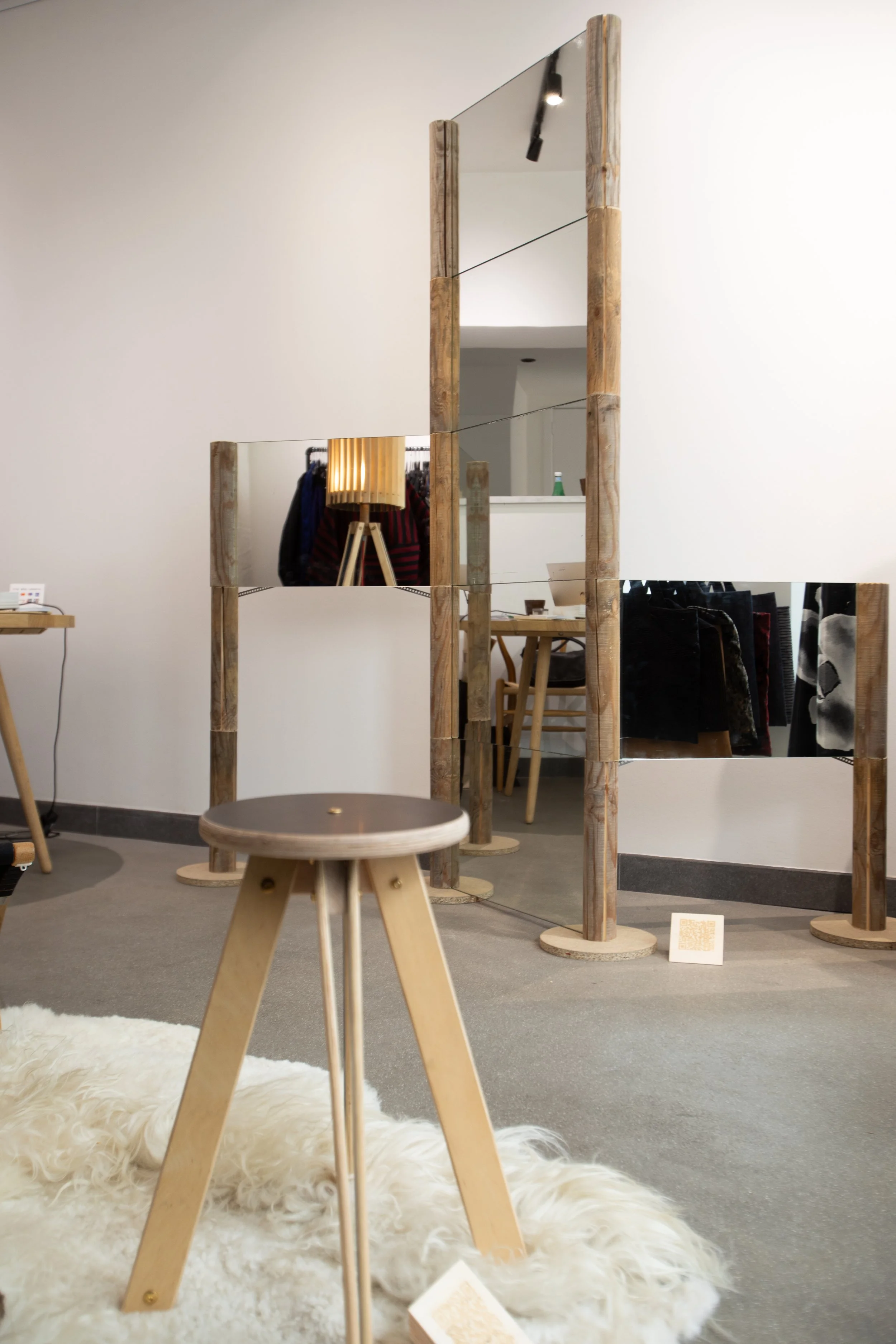
2025
Antwerp
Mod’Arte’s pop-up →
“We worked closely with a designer from May Again’s network to create the mirror for our pop-up. That collaboration made all the difference — it wasn’t just about the object, but about shaping something that really belonged in the space. ”
Francine Heirbaut, Mod'arteGet In Touch
Before we connect, a few questions help us understand the context.
This isn’t a briefing — just a starting point.